
Selling Food at a Market Stall: The Rules in Each State
· LocalMarketSpot
Every state lets you sell food from a market stall, and every state wants to know about it first. Who you register with, what a food safety supervisor is, and the exemptions worth knowing.
Every state and territory lets you sell food from a market stall, and every one of them wants to know about it before you do. The paperwork is not the hard part. The hard part is that each state does it differently: a statewide online system in Victoria, a council licence in Queensland, a free notification form in South Australia, and registration with the territory government rather than a council in the ACT and the Northern Territory.
Here is what each one asks for, taken from each government's own pages. Organisers check, too. Many will ask to see your registration before they give you a site.
What every state agrees on
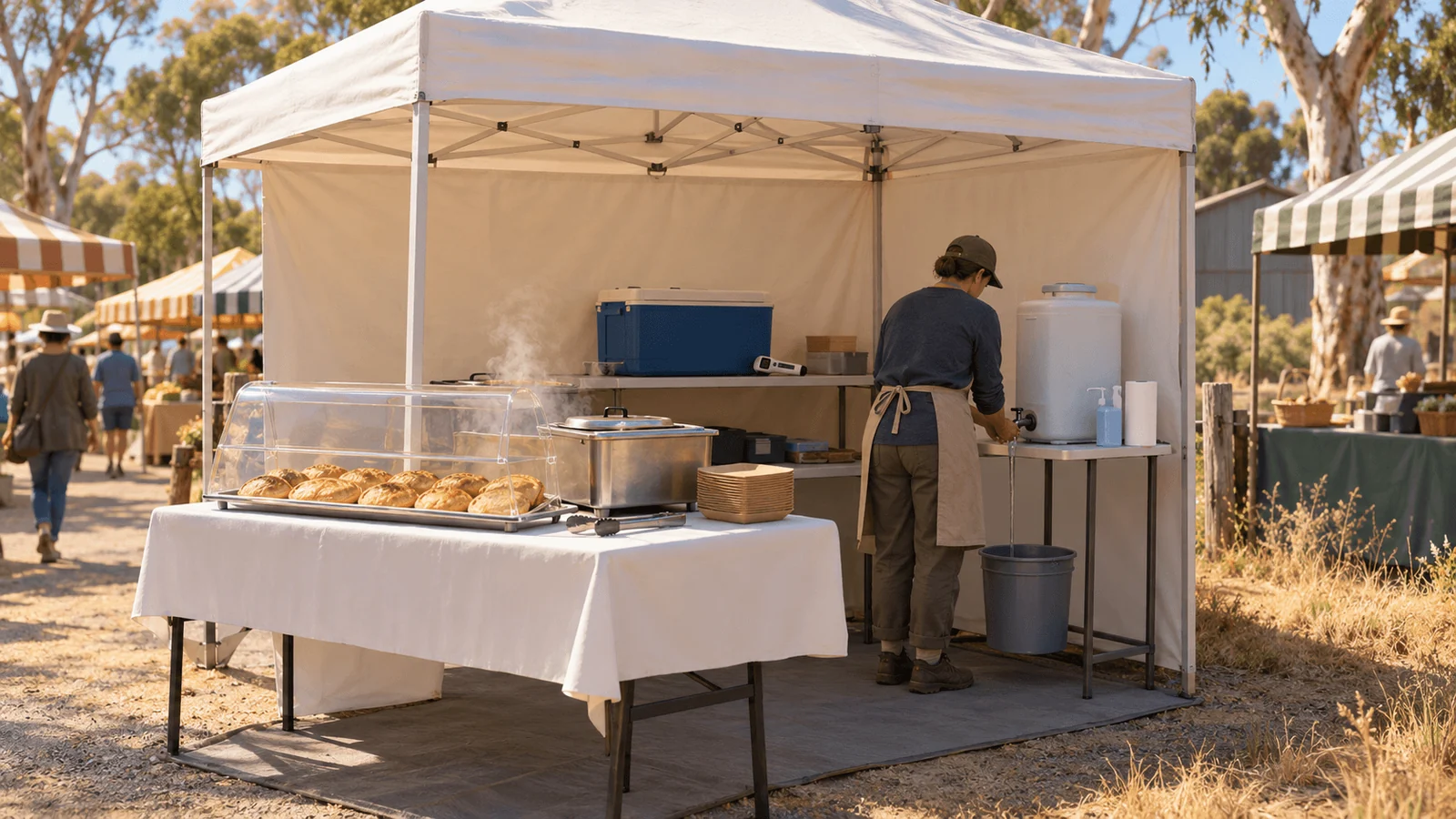
The national rules are the same everywhere. Food Standards Australia New Zealand says a stall, tent or barbecue stand put up for a market and taken down afterwards is a temporary food premises. It has to meet the same food safety requirements as any other food business, regardless of how small it is or how often it trades. Before you start, you notify your council, or in the territories the health agency.
Three things change how much paperwork you face:
Whether the food needs temperature control. Meat, dairy, cooked rice and prepared dishes are "potentially hazardous". Plain cakes, biscuits and bread are not.
Whether it is packaged. Food sealed by a licensed maker is the lightest case almost everywhere.
Whether you are fundraising. Charities and community groups selling low-risk food may not need to notify at all, and a sausage sizzle cooked and eaten on the spot may be exempt from the training rules. Ask the council before relying on it.
The food safety supervisor
If you prepare and serve food that is ready to eat, needs temperature control and is not in its original package, you will usually need a food safety supervisor: someone at the business who holds a certificate from a registered training provider.
The NSW Food Authority is the clearest on how this works at a market. You need one supervisor for each stall, so a business running two stalls at the same event needs two, and a copy of the certificate stays at the stall. In the ACT, every registered food business nominates one, and every stall at a declared event must have one reasonably available all day.
Separately, anyone selling unpackaged, ready-to-eat food that needs temperature control has to make sure the people handling it know basic food safety. That can be a free online course or past experience. It does not have to be a paid certificate.
Victoria: FoodTrader
Victoria runs a statewide online system. Every market stall, food truck and occasionally used hall registers or notifies under the Food Act through FoodTrader with one registering council, and that registration covers you wherever you trade in the state.
Then, for each market, you lodge a Statement of Trade, which tells the councils where and when you will be operating. You cannot lodge one until your registration has come through, so start well before your first market. Many organisers ask to see the Statement of Trade before they confirm your site. At Inverloch Lions Community Farmers Market, food traders register this way and carry their own public liability cover.
FoodTrader only covers the food side. Trading in a public place, such as a street or a park, can need a separate council permit.
New South Wales: tell the council
In NSW you notify the council where the market is held. How you do it depends on the council: a permit, an approval or a notification form. Councils are generally responsible for approving temporary events, and their environmental health officers do the inspections on the day, choosing which stalls to check by risk.
NSW also spells out that stalls are legally required to give customers information on the allergens in what they sell. Have the ingredients written down, not just in your head.
Queensland: a licence for the stall
Under Queensland's Food Act, most food businesses need a licence from their local council: anyone who makes food or sells unpackaged food by retail. The state's list of exemptions is long and specific. You do not need a licence to sell only:
unpackaged snack food, such as cakes and biscuits without cream or custard, lollies, chips and nuts
whole fruit and vegetables
seeds, spices, dried herbs, tea leaves and coffee beans, ground or not
drinks, other than juice squeezed at the stall
ice, flavoured or not.
Non-profit groups only need one if they sell meals they prepared at a particular place on at least 12 days a financial year. Councils run the licences their own way. In Brisbane, a temporary food stall licence covers one stall at organised markets or events, and food pre-packaged by a licensed business needs none.
The catch is home cooking beyond that list. If you prepare food at home that is not exempt and sell it at a market, Brisbane wants a licence for each location, so the home kitchen needs one as well as the stall.
South Australia: a free notification
SA Health asks food businesses to notify their council before they start handling food, using a Food Business Notification form. There is no fee. It applies whether you are a business, a charity or a community group, and whether you sell every week or once. Each site needs its own form, and a food van notifies the council where it is garaged and may need to notify the councils where it trades.
Western Australia: register with the council
In WA every food business, including a market stall or a food van, must be registered with its enforcement agency before it starts trading. For almost everyone that is the local council. Each council keeps its own register, and a Department of Health register helps participating councils keep track of traders who work outside their home district, such as at events in the city.
Food sites are competitive. In Perth, Twilight Hawkers Market fields more than 40 vendors each Friday from a roster of over 70. In Busselton, food stalls at the Lions Vasse Twilight Markets are by invitation only.
The ACT: the Health Protection Service
The ACT is different: registration goes to the Health Protection Service, not a council, and your premises are inspected before registration is granted. Every registered business needs a food safety supervisor.
The exemptions are generous for occasional traders. You do not need to register if you sell food no more than five times a year, for no more than three days each time, and the food is either low risk and unpackaged, like plain scones or whole fruit, or cooked thoroughly and eaten straight away, like a barbecue. Food in closed packaging that does not need temperature control is exempt too. Non-profit groups fundraising with volunteers are exempt from both registration and the supervisor rule.
Big events are the exception. At declared events such as the Enlighten Night Noodle Market and the National Multicultural Festival, every stall needs either a current ACT registration under the same trading name or a registration for that event. Businesses registered interstate, and those normally exempt, must register for it at least 14 days ahead. That registration is free. The stall rules there are specific: a roof, three sides and a washable floor cover, a 20 litre water container with a tap, liquid soap and paper towels (hand sanitiser does not count), cold food at 5°C or below and hot food at 60°C or above. Only low-risk food like plain cakes, biscuits and bread can come from a home kitchen, and only with approval.
Canberra markets with food stalls include the Capital Region Farmers Market and the Handmade Market.
Tasmania: register with the council
In Tasmania, councils register and inspect food businesses. The Department of Health names market stalls and food vans among the businesses that generally need a food safety supervisor, because they sell unpackaged, ready-to-eat food that needs temperature control. Stalls that only handle food for a fundraising event do not. The environmental health officer at your council will tell you whether yours does. Talk to them, and to the organiser, before a first market like World Street Eats in Launceston.
The Northern Territory: register with the NT Government
In the NT a food business registers with the Territory Government, online through Territory Services, before it starts trading. Registration goes to the Territory Government, not a council. You do not need to register if you only sell low-risk packaged food, or if you are raising money for a community or charitable purpose and fall under the territory's exemptions for charities and community events. Registration lasts one year for higher-risk businesses and three for the lowest-risk category. The government's Environmental Health team answers questions, and it is worth calling before a season at Mindil Beach Sunset Market in Darwin.
Before you apply for a food site
Ask the organiser first. Food is the category markets fill fastest. Kiama Seaside Markets is not taking new food stalls or food trucks at all right now, and some markets only take food that fits a theme, like the all plant-based Alive Festival in Gosford.
Budget for a higher site fee. The Beaches Market at Palm Beach charges $140 for a hot food stall against $120 for a non-food space. Put the fee, the registration and the stock into the market stall profit calculator before you commit.
Allow weeks, not days. Registration, inspection and, in Victoria, a Statement of Trade all have to happen before your first market.
Plan the hand washing. Running water, soap and paper towels at the stall is the setup inspectors look for first.
For the rest of getting a stall, from site sizes and insurance to how applications work, see how to get a market stall. The market stall checklist covers what to pack.
Frequently Asked Questions
- Do I need a permit to sell food at a market in Australia?
- Almost always. Food Standards Australia New Zealand says a market stall has to meet the same food safety rules as any food business, whatever its size and however often it trades, and that you notify your council before you start. Some low-risk and charity stalls are exempt. What that looks like differs: Victoria registers stalls through FoodTrader, Queensland councils issue a licence, South Australia asks for a free notification, and the ACT registers through its Health Protection Service.
- Can I sell food I cooked at home at a market?
- Only within limits. In Queensland, plain cakes, biscuits without cream or custard, lollies and nuts need no licence at all, but in Brisbane anything outside that exempt list that is prepared at home for a market needs a council licence for the home kitchen as well as one for the stall. At ACT declared events, only low-risk food such as plain cakes, biscuits and bread can come from a home kitchen, and the Health Protection Service has to approve it.
- What food can I sell without a licence?
- Low-risk food, and in most places food that stays sealed. Queensland needs no licence for stalls selling only cakes and biscuits without cream or custard, lollies, nuts, whole fruit and vegetables or drinks other than juice made at the stall. The ACT exempts food in closed packaging that does not need temperature control, and the NT exempts low-risk packaged food. Charities and community groups selling only low-risk food may not need to notify at all, but check with the council first.
- Do I need a food safety supervisor for a market stall?
- If you prepare and serve food that is ready to eat, needs temperature control and is not in its original package, usually yes. In NSW that means one certified supervisor per stall, with a copy of the certificate kept at the stall. In the ACT every registered food business has to nominate one, and every stall at a declared event needs one.