
Trash and Treasure: Flea, Vintage and Antique Markets in Australia
· LocalMarketSpot
A dawn car park full of other people's sheds, a curated vintage market once a month, and a warehouse of dealers open every day are three different outings. Here is where each one is, and when to go.
"Flea market" covers three quite different mornings out, and picking the wrong one is the usual disappointment. A trash and treasure market is a car park of private sellers at dawn, and the best of it is gone by 10. A curated vintage market is a monthly event where every stall has been chosen. A vintage hall is a warehouse of dealers that opens most days of the week and needs no planning at all.
What they share is the rule that makes secondhand shopping work: come early for the good stuff, come late to bargain. Everything on the table exists in a quantity of one.
Three kinds of secondhand market
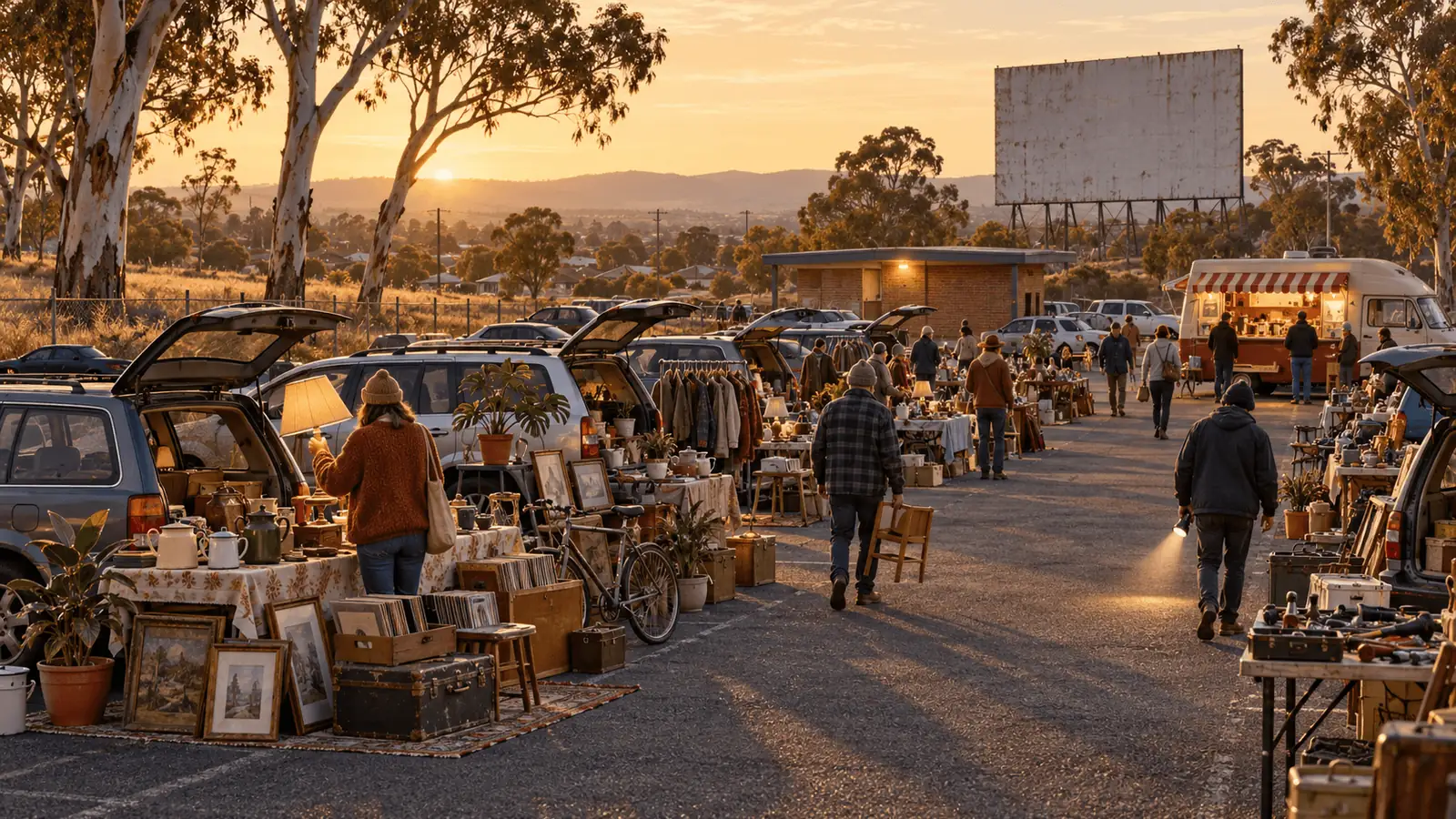
Trash and treasure. The Australian flea market. Trash & Treasure Australia started in Melbourne in 1967 with what it calls an entirely new idea: a place where people could legally sell secondhand goods to each other. You load the car, hire a table and sell. The stock changes every week because the sellers do, and most of these markets run on a Sunday in a car park, a drive-in or a showground.
Car boot markets are the same idea run by a club, usually once a month, with sellers working out of their boots. The site fee goes to the club's projects, which keeps it low: $10 to $25 at the markets below.
Vintage halls and antique malls. Permanent warehouses where dozens of dealers each lease a space. Prices are higher and nothing is a surprise to the seller, but most open every day and none of them care what time you arrive.
The flea and vintage section of the directory lists 27 of these markets. Twenty of them open on a Sunday. If you only have a Saturday, the choice narrows to the curated vintage markets and the halls.
Melbourne's Sunday car parks
Melbourne invented the format and still has the most of it.
Camberwell Sunday Market is the famous one. Balwyn Rotary started it in a suburban car park in 1976 with 48 stalls and $531 in takings. It now has more than 380 stalls of bric-a-brac, vintage clothing, records, books and hardware, around 250,000 visitors a year, and more than $16 million raised from gold coin donations at the gate. It runs from 7am and is wrapped up by 12:30pm.
Two of Trash & Treasure's three Melbourne markets trade on drive-in sites. Coburg is on the Village Drive-In on Newlands Road. Buyers' gates open at 8am, and an early bird ticket before 8 costs $6 against $1.50 for ordinary entry, which tells you when the good things go. Wantirna is on the old Hoyts drive-in on Mountain Highway. The market rented the site in the 1970s and bought it in 1983, a year before the last film. Peter Muller's brick snack bar and the ticket booth are still standing, and the National Trust lists the site. Both close at 2pm, and neither allows dogs.
Bentleigh Sunday Market has run every Sunday since 1977 in the car park behind Bentleigh station, so it is the easy one to reach by train. It has more than 130 stalls, from 7am to midday, for a gold coin. Laverton Market began in 1974 as Rubble & Riches and is now a 14-hectare site with around 1,400 stalls across two indoor pavilions and an outdoor section where sellers still trade from their cars. It is open Saturday and Sunday, 7am to 4pm, at $2 a person or $5 a car.
Down the highway, The Belmont Market has traded on Sundays at Geelong's Barwon Valley Activity Centre since the 1970s and is known locally as Geelong's biggest garage sale, with more than 200 sites.
Vintage halls that open every day
These are the answer to "is there anything on today?". They hold more stock than any Sunday market. Some of it is priced by people who know exactly what it is worth.
Geelong Vintage Market fills 4,000 square metres of the old Pilkington glass factory at 3 Mackey Street, North Geelong, with more than 60 stalls. Enamel signs and workshop gear are the speciality. It trades 10am to 6pm every day, public holidays included, and closes only on Christmas Day. In Fitzroy, Lost and Found Market started in 2005 in an abandoned Collingwood nightclub and now has about 1,000 square metres of a heritage building at 288 Brunswick Street.
Central Victoria has the big ones. The Mill Castlemaine is in the 1875 Castlemaine Woollen Mill, with antiques, curios and crockery under one air-conditioned roof, in a building shared by more than 40 businesses. The Amazing Mill Markets in Daylesford covers 12,000 square metres, close to three acres, with stock from the 1850s onward. Both open daily, and a Castlemaine and Daylesford day takes in both. Closer to the city, Market Fair in Ferntree Gully has opened seven days since 2016, with antiques, memorabilia and collectables among the handmade stalls.
Outside Victoria, Dirty Janes has more than 90 stallholders in a warehouse in Fyshwick, Canberra, open 10am to 5pm every day. Sunshine Coast Vintage Market is a shopfront on the Mooloolaba Esplanade where around fifteen sellers share the racks: vintage clothing, vinyl and streetwear, Wednesday to Sunday, 10am to 4pm.
Country Victoria, once a month
The monthly country markets are where the bric-a-brac is cheapest, because the sellers are clearing sheds rather than running a business.
Wallan Old Time Market fills Hadfield Park with about 200 stalls on the second Saturday of the month, 45 minutes up the Hume from Melbourne. The Scouts run it, bric-a-brac leads, and the good stuff moves in the first hour. Quercus Flea Market in Beechworth takes over the grounds of a heritage church on the first Saturday of the month from October to May, with no bookings and a $20 table fee. The Beechworth Farmers Market runs the same morning along Ford Street.
Stratford Sunday Market in Gippsland has the oddest calendar in the state: it trades only on a fifth Sunday, 9am to 1pm. The next ones are 29 November 2026, then 31 January, 30 May, 29 August and 31 October 2027. How monthly markets work explains why a fifth Sunday is not the same as the last one.
Back in the city, Fitzroy Market on Rose Street is the strict end of the scale. Everything must be secondhand or handmade, and stock bought from Temu, Shein or AliBaba is banned. It runs Saturday 9am to 3pm and Sunday 10am to 3pm, and dogs are welcome.
Sydney and the Central Coast
Surry Hills Market has run on the first Saturday of the month at Shannon Reserve on Crown Street since 1981. It takes only handmade, secondhand and recycled goods, with no food or coffee stalls at all, which is why it now trades as Surry Hills Vintage Market. About 60 stalls trade from 8am to 4pm, and the cafes of Crown Street do the catering. Rozelle Collectors Markets has run every Saturday since the mid-1970s in the grounds of Rozelle Public School: antiques, collectibles, records and clothes, 9am to 3pm.
Sunday is Bankstown Market, every week since 1966 on the Bankstown Paceway at Condell Park, from 8am to 2pm. It has secondhand goods and tools among the fruit and vegetables.
On the Central Coast, the Terrigal Wamberal Lions car boot market opens at 6:30am on the first Sunday of the month at Terrigal Lagoon Reserve. The serious buying is done before most markets have set up. The Central Coast Vintage & Collectibles Fair in East Gosford runs only a few weekends a year, so the dealers travel in for it. Saturday is the dealer day inside the hall, and Sunday adds a boot market outside.
Brisbane and the Sunshine Coast
Brisbane's secondhand markets keep the same early hours as its produce markets. Meadowlands Community Market in Carina is a car boot market on the first Saturday of the month, 7:30 to 11:30am. Households sell there rather than traders, so bring small notes. Love Me Again Market is the clothing version: each stall is one person's wardrobe, sold by its owner, from 8am at Morningside on most Sundays. The best racks are picked over by mid-morning.
Up the coast, Nambour Rummagers Market sets up vintage and secondhand stalls on the Nambour Library forecourt on the third Sunday of the month, 9am to noon. Its last market for 2026 is 15 November, and it returns in February 2027.
Adelaide, Perth and Canberra
The Original Open Market has traded at The Reserve on Beach Road, Christies Beach, since 1982, on the first and third Sundays. Sellers pay from $15 to park a car and sell from it, and the fees go back to the community as donations, more than $150,000 so far.
Perth's is for early risers. Belmont Rotary's Rotamart fills the Belmont Forum car park every Sunday from 5:30am to 10:15am, except in December. Only preloved goods and potted plants may be sold, with no new stock and no food vans. If you arrive at 9:30, you have caught the tail end. The Pre-Loved Market at FOMO Freo is a clothing market with more than 100 sellers, held on dates that move between Saturdays and Sundays, so check the date rather than the day.
Canberra's Sunday market at the Jamison Centre began in 1974, when Belconnen Rotarians who had seen Trash & Treasure in Melbourne brought the idea home. It runs 6:30am to 12:30pm in all weather and skips only a Christmas Day Sunday. Fruit and vegetables are now the biggest category, with secondhand tools, jars and parts among them, and more than $8 million has been raised so far.
How to shop one
Arrive at the opening for the good stuff. At a car park market, the dealers are through the gate first, and some markets charge for the privilege, like Coburg's $6 early bird ticket.
Stay for the last hour to bargain. Sellers would rather not load it back into the car. The range is thinner by then, as reviewers of the Trash & Treasure markets point out.
Bring small notes and coins. Car park sellers are households, not shops, and few have card readers. The vintage halls are more likely to take cards.
Bring bags, and a tape measure for furniture. Nothing at a car boot market comes wrapped.
Check the dog rules. Coburg and Wantirna do not allow dogs, and Canberra asks you to leave yours at home. Fitzroy and Christies Beach welcome them.
For the other kinds of market and what separates them, see types of markets in Australia. For what is on this Sunday, markets this weekend does the working out.
Frequently Asked Questions
- What is a trash and treasure market?
- The Australian name for a flea market: a car park, drive-in or showground where people sell their own secondhand goods, usually from the back of the car. The format began in Melbourne in 1967, when Trash & Treasure Australia opened a place where people could legally sell secondhand goods to each other. Most still run on Sunday mornings and are best before 9am.
- What is the best day for flea markets in Australia?
- Sunday. Of the 27 listings filed under flea and vintage on this site, 20 open on a Sunday, and most of the car park markets are Sunday-only. Saturday has a few curated vintage markets, such as Surry Hills on the first Saturday and Rozelle every Saturday in Sydney.
- Are there vintage markets open every day?
- Yes, the warehouse kind. Geelong Vintage Market, Lost and Found in Fitzroy, The Mill in Castlemaine, the Amazing Mill Markets in Daylesford, Market Fair in Ferntree Gully and Dirty Janes in Canberra all trade seven days. Sunshine Coast Vintage Market in Mooloolaba trades Wednesday to Sunday.
- Can I bring my dog to a flea market?
- Often not. Dogs are not allowed at the Coburg and Wantirna Trash & Treasure markets, and Canberra's Sunday market at the Jamison Centre asks you to leave the dog at home. Fitzroy Market in Melbourne and the Original Open Market at Christies Beach welcome them. Check the listing before you bring one.